
Last summer, we brought equipment to market. This year, we realized that we were actually building something else.
That is not a marketing figure of speech. It is the most honest description of the year behind us.
Where we started: equipment that worked
Last summer, we launched the ScubaLineRetractor (SLR25) – specialized equipment for spearfishing that was adopted by the market faster than we expected. Then came confirmation from another side: an innovation award in the category “most original and market-oriented innovation.”
The award was nice. More important to us was something else: for the first time, we had proof that we knew how to take a product from an idea to the shelf: manufacturing, certification, distribution, sales, users. That is something you cannot simulate with an Excel spreadsheet.
And that is where the interesting part began for our team.
The logical next step would have been another piece of equipment. We did not build it.
When a product works, the easiest thing to do is build the next piece of equipment. Then another one. And another one. You build a catalog, expand distribution, optimize margins.
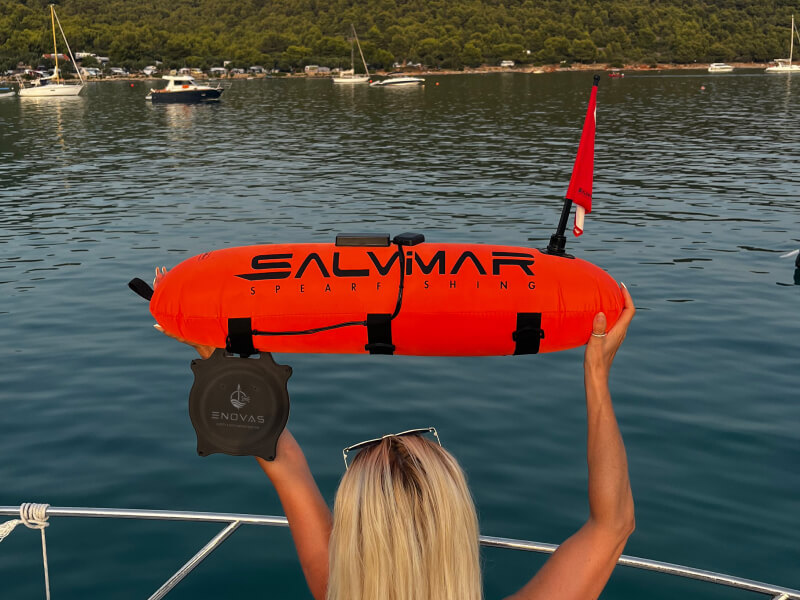
We chose differently and, figuratively speaking, closed ourselves in our offices for more than a year. Until this summer, when, right at the end, we were finally able to take some interesting photographs of the “new story.”
The reason was simple. When we listened to users, none of the serious stories revolved around equipment. They revolved around uncertainty:
→ a diver disappears beneath the surface and nobody on the boat knows exactly where they are
→ when an incident occurs, rescuers search for a person across an area of several square kilometers
→ there is no reliable dataset showing how much and what is actually being caught beneath the surface
→ regulators are managing a sector they cannot actually see
None of these problems can be solved with a better housing. All four require a system that produces data.
What we built: a software module that changes the product category
Over the past year, we upgraded the equipment with a high-tech software module and connected it to our own platform. The result is a two-part system:
Surface – equipment at the surface. Real-time GPS/GNSS location, a one-press SOS function, visibility for vessels, and automatic dive logging.
Aquadata – a data platform. It stores, processes and visualizes everything the system collects: dive locations, dive duration, fishing effort, movement patterns, and optionally recorded catch.
From this point on, every dive is no longer simply a dive. It is a structured data record.
This transition is not cosmetic. It moves the product from the category of diving equipment into the category of safety & data infrastructure and fundamentally changes who the customer is, who the payer is and what the value of the company is.
The vision changed too – deliberately
We started with the ambition of helping spearfishers stay safe while diving.
Today, the ambition is broader: to digitalize a sector that has existed and operated all along without a system.
In practical terms, that means five things at once:
1. Safety. In the event of an incident, the diver’s precise location is transmitted directly to rescue services. Every minute of searching is a minute not spent on what matters: the rescue itself.
2. Transparency and traceability. Where fishing takes place, when, and at what intensity. Measurable for the first time, rather than estimated.
3. Monitoring fish populations. Long-term collection of catch data by species and zones is the only realistic basis for sustainable quotas in recreational fishing.
4. Lower search costs and fewer emissions. A shorter search operation means fewer hours of vessels at sea, less fuel consumed and fewer CO₂ emissions, as well as a greater chance of survival for the person in distress. This effect is measurable, and we intend to measure it.
5. Data for research institutions. Aggregated, anonymized datasets on recreational fishing that simply did not exist before.
Why now?: regulation moved first
This is not a prediction about the future. It is about regulation that is already in force.
Regulation (EU) 2023/2842 has been in force since January 2024 and systematically brings recreational fisheries into the European control system for the first time: electronic catch reporting, digital monitoring and data collection.
Commission Implementing Regulation (EU) 2025/274 is the first concrete implementing act for recreational fisheries, standardized data collection and catch reporting.
2026 brings the introduction of digital reporting for recreational fishers, with full implementation of the system envisaged by 2028.
Spearfishing is not specifically highlighted in these texts. Legally, however, it falls under recreational fisheries, which means it will be included.
This is precisely where the gap that matters to us as a company appears:
The EU is introducing catch reporting. It is not introducing precise location, real-time tracking and a safety layer. Surface + Aquadata is exactly that missing layer.
That is why we do not position our system as surveillance of fishers. We position it as safety infrastructure that, as a by-product, solves the regulator’s data problem. That distinction is not semantic; it is the difference between acceptance and resistance in a highly connected community that, throughout the history of diving, has developed practices and understandings in which structured data was the last thing on anyone’s mind.
Market size: a small niche within a very large system
This is where precision matters, because this is exactly the point at which too many teams lose sight of reality.
Recreational marine fishing in Europe is a serious economic sector: approximately 8.7 million recreational marine fishers, equivalent to 1.6% of the population, 77.6 million fishing days per year and EUR 5.9 billion in annual direct expenditure. The total economic impact is estimated at EUR 10.5 billion annually and approximately 100,000 jobs. (Hyder et al., 2017/2018; ICES Journal of Marine Science.)
Spearfishing is a minority discipline within this sector – according to scientific estimates, less than 5% of recreational marine fishers. That puts the order of magnitude at approximately 430,000 spearfishers in Europe, with a strong concentration in the Mediterranean and Adriatic.
Even so, these are only estimates, because nobody actually knows how many spearfishers there are in total (that is the part where we realized that this sector operates without visibility).
Our understanding of this is not:
“The market is huge.”
We see it differently:
“The user market is manageable and sufficiently dense to make a pilot deployment realistic. The real value is not in one-off equipment sales; it is in the data layer produced by that user base.”
That is why the system has three separate revenue streams: divers buy the equipment, institutions buy access to the data, and research organizations buy aggregated datasets. One system, three payers. The point at which Surface stops being merely a piece of equipment.
Why Croatia
Croatia is our first market for three reasons that reinforce one another:
Scale. The Adriatic is one of the densest areas for recreational and spearfishing in the Mediterranean, and therefore also an area with significant real-world incidents.
Institutional readiness. Croatia is actively modernizing its fleet, monitoring and safety at sea. There are clear potential counterparts, such as SAR (Search and Rescue) services and research institutions such as IZOR (Institute of Oceanography and Fisheries).
Precedent. What works in the Adriatic can be transferred to Italy, Spain, Greece and beyond. Every coastal EU member state will be addressing the same problem in the coming years.
We are currently discussing pilot projects. The planned scope of the pilot is 1,000 users over a period of 36 months – large enough to produce statistically useful data and small enough to be feasible.
Where we are today
We have a working MVP. Not a concept, not a render, not a simulation. A working prototype that we can demonstrate live.
Three processes are running in parallel:
→ Funding calls. The primary framework is EMFAF (European Maritime, Fisheries and Aquaculture Fund) – a fund with a budget of approximately EUR 6.1 billion for 2021–2027, directly supporting fisheries digitalization, data collection, safety at sea and innovation. Applications do not go to Brussels, but through national managing authorities.
→ Pilot projects. Croatia, in cooperation with fishing organizations, rescue services and research institutes.
→ Financing. Based on pilot results and signed letters of intent, we are preparing an investment round to scale the platform.
What we do not promise
We do not claim that we will save X lives per year. We do not claim that we will reduce emissions by Y tonnes. There is no data basis for such claims today – precisely because the sector is data-poor.
What we do claim is this: the pilot will, for the first time in this sector, produce numbers that make these claims testable. The methodology, sample size and measured indicators are defined in advance: time to localization, vessel hours per intervention, fuel consumption, recorded fishing time by zone, fishing effort, locations, etc.
We are committed to the second part as well: we will publish the results as they are. Even if they are more modest than our internal expectations.
A sector without data does not need another optimistic projection – it needs its first honest measurement.
We started with equipment. We realized that it could collect data. From the data, we built a system. And that system is now becoming infrastructure that can change the way we understand what happens beneath the surface.
What we are looking for
Pilot partners: fishing clubs, associations and regional agencies willing to test the system in real-world conditions.
Institutional counterparts: rescue services, research institutes, ministries and fisheries-area managers interested in understanding what is actually happening beneath the surface.
Investors who understand the difference between selling equipment and building infrastructure.
If you are in one of these three groups, get in touch. We will show you a working system, not a PowerPoint presentation.
Enovas develops Surface + Aquadata; safety and data infrastructure for spearfishing, aligned with the objectives of the European Green Deal, the Common Fisheries Policy and the digitalization of fisheries control in the EU.